

TOW builds The Only Workspace, a company wiki software platform that combines docs, search, role-based permissions, project context, and reviewable AI in one workspace. If you need a wiki your team can trust for daily decisions, not just a place to park documents, TOW gives you a controlled, searchable system you can run in the cloud or on your own infrastructure.
Most teams do not struggle because they lack pages. They struggle because knowledge is split across docs, tickets, decisions, and private channels, and because the wrong people either cannot find what they need or can see more than they should. TOW is designed to solve both problems at once with native docs, workspace-wide search, and explicit governed access.
TOW company wiki software for durable company knowledge
TOW Docs is the native wiki inside the TOW workspace, built for long-form company context that people should read, maintain, search, cite, and use as source material for Memory. That makes your wiki useful beyond documentation alone, because the content can support search, decisions, and AI-assisted work inside the same system.
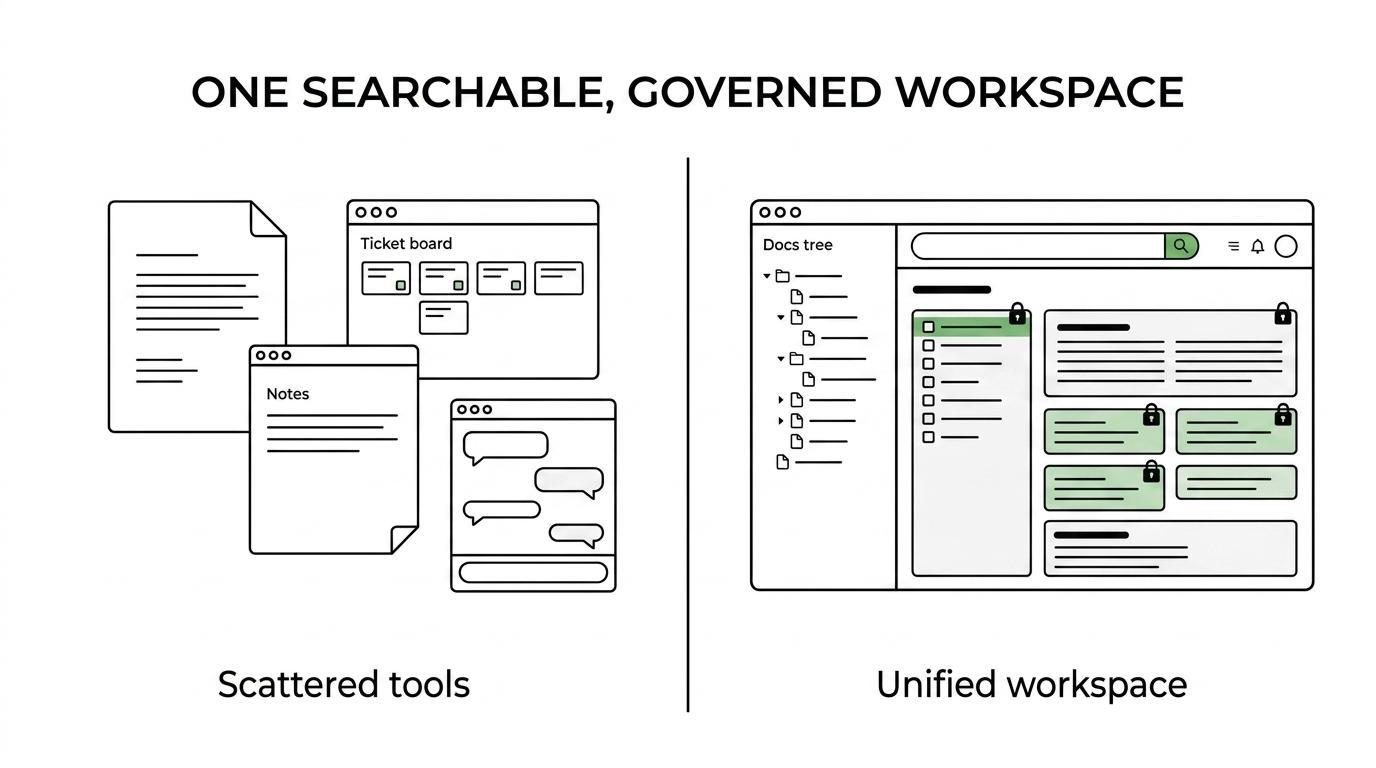
TOW’s docs tree supports top-level pages for a product area, customer, team, or operating function. You can organize knowledge in the way your business already works, which makes it easier for employees to understand where information belongs and where to look first.
“TOW Docs is built for long-form company context, with top-level pages for a product area, customer, team, or operating function.”
Because TOW is also a unified workspace for projects, goals, roadmaps, and collaboration, your wiki does not have to sit apart from the work it explains. Product requirements, operating procedures, customer context, and internal decisions can live closer to the teams using them.
Searchable wiki software that reaches docs, memory, tickets, and decisions
TOW does not limit search to static wiki pages. TOW search can work across Memory, Docs, snapshots, tickets, decisions, risks, and events depending on the view, so you can look for an answer across the places where company knowledge is actually created.
“TOW search spans Docs, Memory, tickets, decisions, risks, snapshots, and events, not just wiki pages.”
That matters because search friction is a real cost. McKinsey has reported that knowledge workers spend roughly 20% of the day searching for and gathering information, and TOW is built to reduce that drag by giving your team one workspace to search instead of several disconnected tools.
TOW also gives you practical ways to improve findability over time. Search results are strongest when titles, headings, tags, and reference IDs are clear, which means your team can make the wiki easier to use with better document structure rather than a heavy governance program.
Just as important, TOW search is designed to respect access. Direct document access continues to work, and search does not rely on a stale permission cache to expose unauthorized documents, so speed does not come at the expense of control.
Role-based permissions for company wiki access at the organization, project, and document levels
TOW applies explicit access control at the organization, project, and document levels. For teams managing internal operations, customer information, leadership decisions, or product plans in one wiki, that gives you a clear way to decide what stays broadly readable and what requires a tighter grant.
“TOW uses role-based permissions across the organization, project, and document levels for governed wiki access.”
In TOW, a role defines the permission level a person has in the organization or in a project. Open projects usually let organization members read and work in the project, while restricted projects require a direct grant, a group grant, or elevated organizational privileges.
That model fits how real organizations work. NIST defines role-based access control as access control based on user roles, and notes that RBAC reduces the cost and complexity of security administration for large networked applications. TOW brings that logic to company knowledge, so permissions can follow team structure more naturally than one-off page sharing.
Self-hosted or cloud wiki software with data ownership, admin controls, and reviewable AI
TOW offers your wiki in self-hosted and cloud deployment options, which is important when data ownership and infrastructure control are part of the buying decision. If you need to keep the workspace on your own infrastructure, TOW supports that without giving up integrated docs, search, memory, and project management.
TOW also includes admin and auth capabilities, plus AI options that fit different operating models. You can use BYOK or TOW-managed AI endpoints, and TOW’s AI actions are workspace-aware, permission-aware, and reviewable by humans, which helps you use AI on company knowledge without turning the wiki into an uncontrolled black box.
For smaller organizations, TOW offers a free self-hosted tier. That gives teams a lower-risk way to validate structure, permissions, search behavior, and adoption before expanding their rollout.
TOW wiki software for teams replacing scattered docs, Confluence, Notion, or disconnected project tools
TOW is a strong fit when your team wants more than a standalone wiki. If your current setup spreads knowledge across a docs tool, a project tracker, team notes, and separate AI utilities, TOW brings those functions together so context does not get lost between systems.
TOW also supports migrations from Jira, Confluence, and Notion. That can make adoption much more practical, because replacing wiki software often fails when teams have to rebuild structure manually or abandon historical knowledge to start fresh.
TOW is especially relevant if your team needs:
- Governed knowledge access: Role-based permissions with explicit control at the organization, project, and document levels.
- Search beyond documents: A search layer that can span docs, memory, tickets, decisions, risks, snapshots, and events.
- Deployment flexibility: A cloud workspace or a self-hosted wiki with clearer data ownership and admin control.
- A connected knowledge system: Docs that support Memory and AI inside the same workspace where projects and decisions already live.
If you are looking for company wiki software that makes knowledge easier to find without weakening permissions, TOW is built for that balance. Start with a self-hosted deployment or talk with TOW about your wiki structure, migration path, and access model so your team can move from scattered documentation to one searchable, governed workspace.